Architecture · Notebook entry
Cuypers, and the long renovation.
The Rijksmuseum is a museum object in its own right. Pierre Cuypers designed it in 1885 as a hybrid cathedral; a decade of restoration finished in 2013 returned much of his original intention. Both phases are worth understanding before walking in.
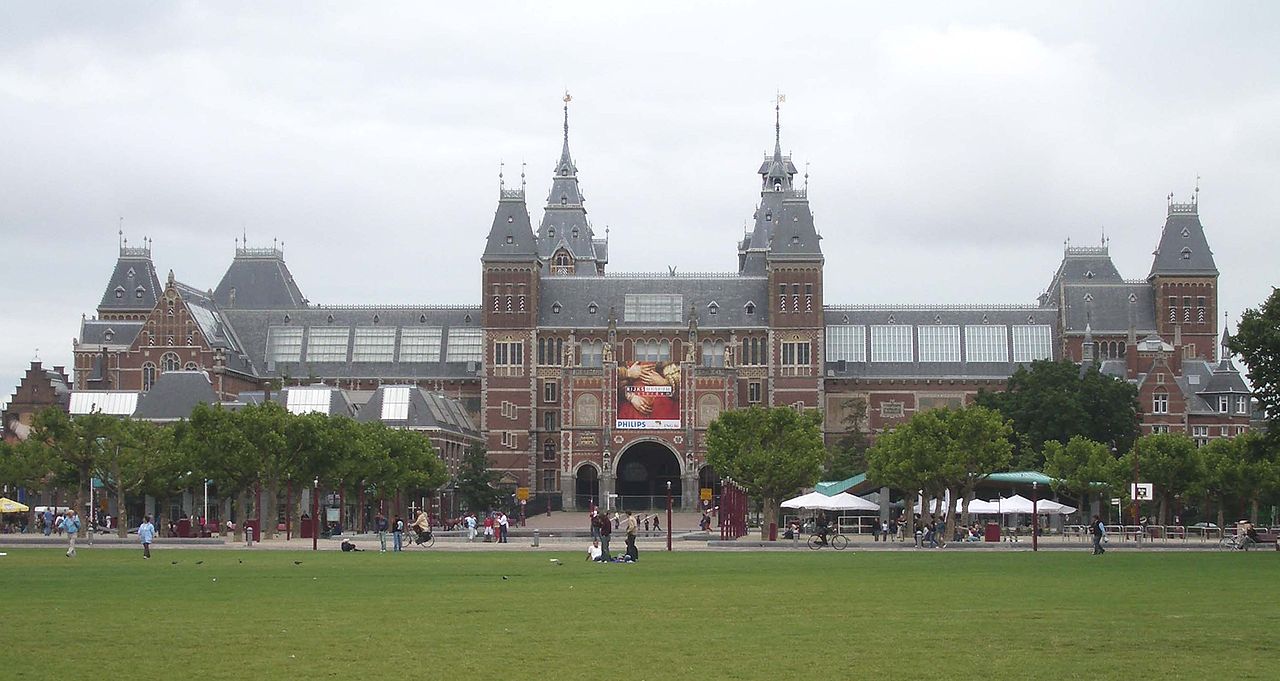
An architect with a programme
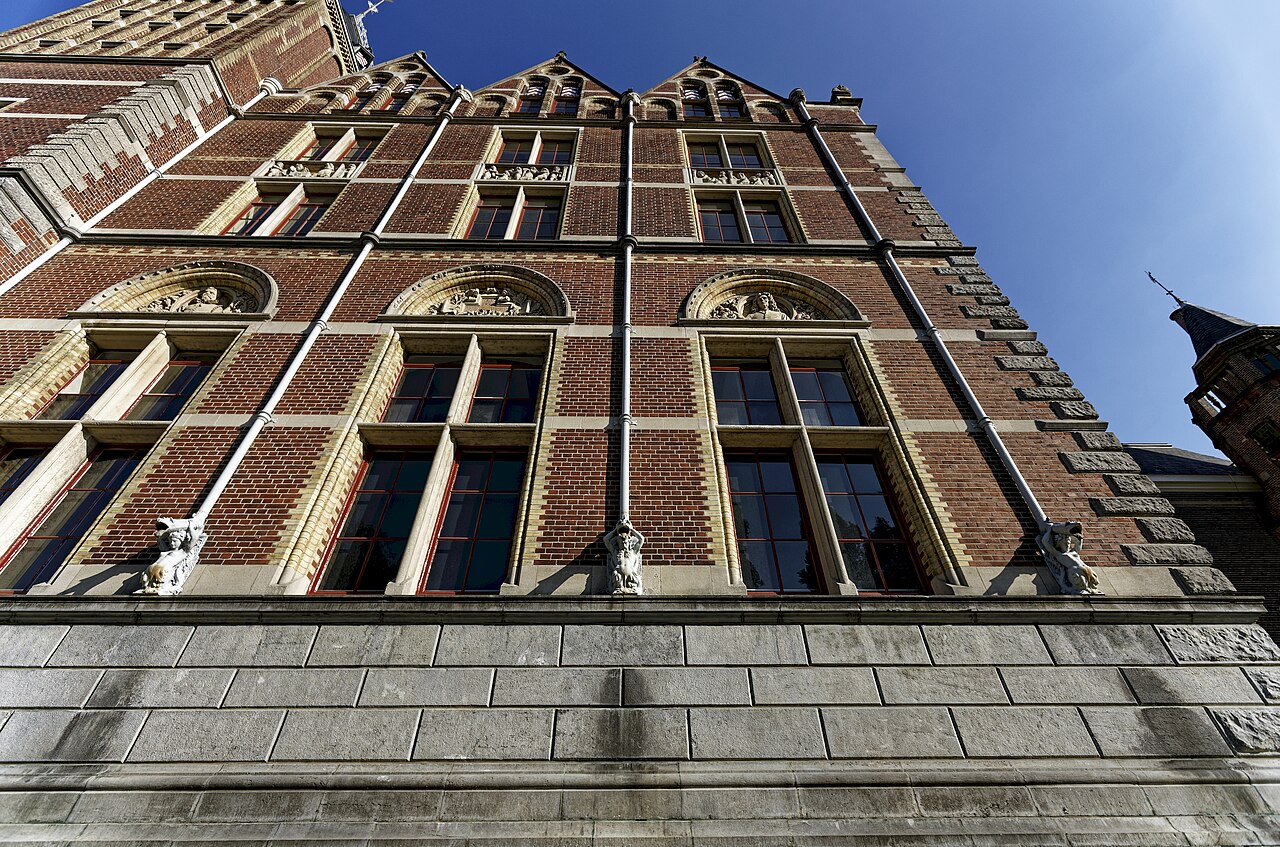
When Pierre Cuypers won the competition for the building in 1876, he was already known for his churches. The Catholic Cuypers had a definite idea of what a national museum should look like: it should look, more or less, like a Dutch parish church grown to civic scale. The plan is symmetrical, with two interior courtyards and a long central passage punched through the middle, allowing pedestrians and cyclists to pass under the building from north to south. The roof line bristles with turrets and gables; the brickwork is patterned; the stone window frames are carved with portraits of Dutch artists, in order of historical importance.
The result was unpopular almost from the moment it opened. King William III, a Protestant who disliked Cuypers's Catholic ornamentation, refused to attend the opening ceremony in 1885 and reportedly never visited the building. Critics of the time complained that the museum looked nothing like a museum — a sentiment that would, in different forms, recur for the next hundred and twenty years.
The damage of the twentieth century
Over the next century, the interior was steadily simplified. Cuypers's hand-painted murals were covered over in white plaster after the First World War, when bright walls were thought hostile to the viewing of art. The Gallery of Honour was sub-divided. Skylights were closed. The two great interior courtyards were turned into windowless storage halls. By the 1970s the building was, internally, almost unrecognisable: a maze of low corridors, fluorescent lighting and dropped ceilings.
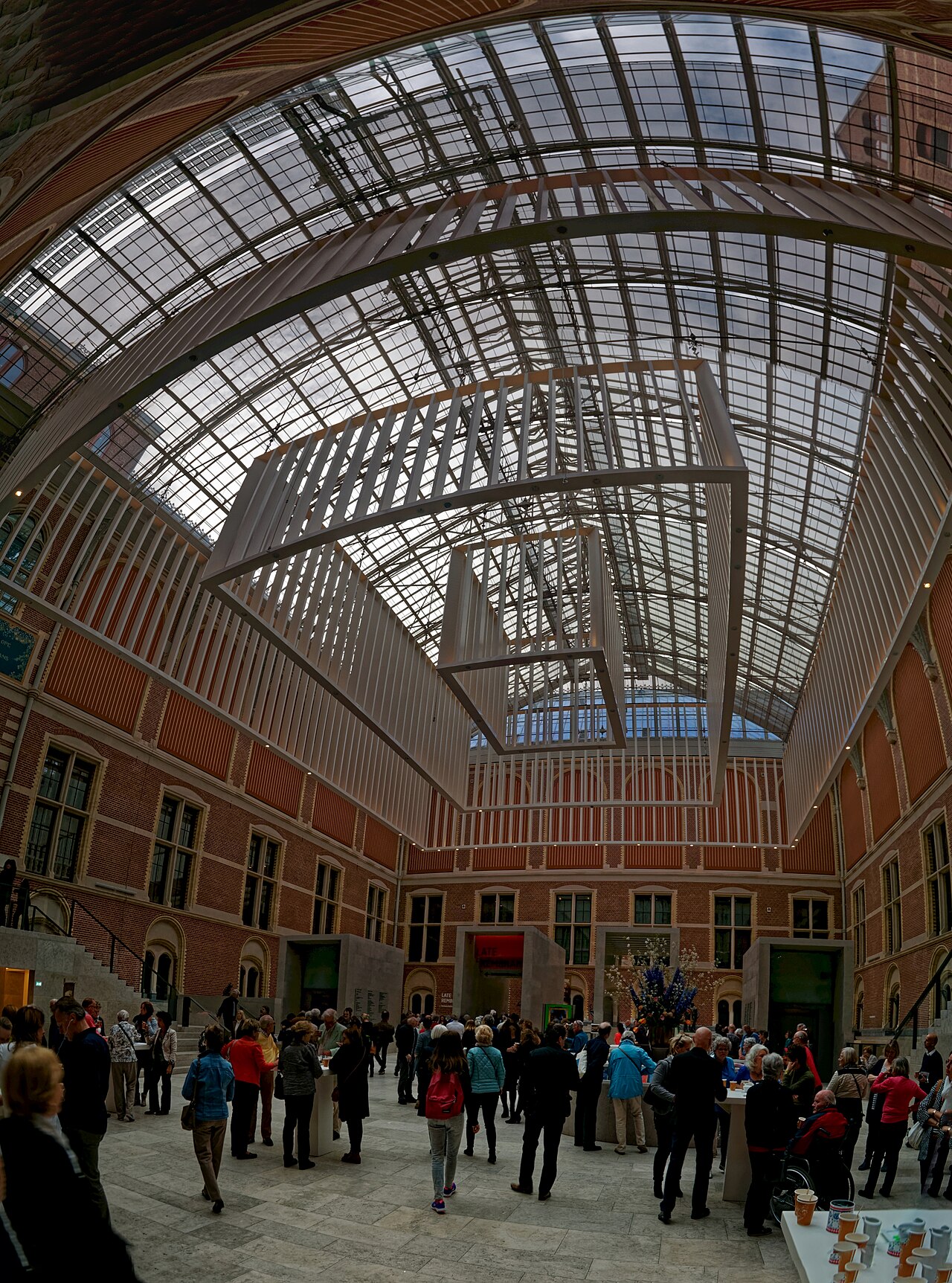
The Dutch architects Cruz y Ortiz won the competition to restore the building in 2001. Their proposal was unusual. Rather than design a new building, they would undo a hundred years of additions and bring back the building Cuypers had finished in 1885 — with one significant new gesture: they would open the two courtyards as a single, sunken Atrium that visitors would enter from below. The bicycle passage through the centre of the building would be preserved.
The Atrium
The Atrium is the easiest part of the renovation to admire. A wide, daylit hall sits one storey below the level of the entrance plaza. The two long sides of the hall are the original Cuypers façades, which had previously been interior walls of the closed courtyards. Visitors descend a long staircase into the space and then, after the ticket desk, ascend through a stair tower into the museum proper. Standing on the Atrium floor, with the brick façades on either side, gives a clearer reading of Cuypers's original exterior than the actual exterior does: the windows still have their gables, the brickwork is original, the carved stonework is intact.
What was restored upstairs
The greater achievement of the restoration is upstairs. The Gallery of Honour was returned to a single open space; its dropped ceilings were removed and its hand-painted vaulting, hidden since the First World War, was cleaned and partially repainted. The skylights were reopened. The stencilled walls in the medieval rooms were rediscovered and conserved. The Cuypers Library was returned to a working state and is once more in use by researchers; the public can look down into it from a balcony on the second floor.
The work took ten years and cost just under four hundred million euros. The museum reopened on 13 April 2013. Most reviewers concluded that Cuypers had been right all along, and that the twentieth century had been wrong.
"The building has been allowed to be a building again." — a Dutch newspaper critic, the week of the reopening.
A few things to look for
- The bicycle passage. It runs north–south under the building. Stand inside it and look up at the painted ceiling; the cyclists have not, traditionally, looked up.
- The Great Hall on the second floor. Stained glass on both sides, vaulted ceiling, and tile floor — the most explicitly cathedral-like space in the building.
- The stair tower at the south end of the Atrium. The carved stone medallions on the wall mark out the names of the eight architects Cuypers most admired.
- The garden. Free to enter, and arranged as a small encyclopaedic landscape with hedges, fragments of demolished buildings, a fountain and a children's pavilion.
Back to the home page, or read more about this notebook.