Painting · Notebook entry
A second look at The Night Watch.
The painting is large, busy and famously misnamed. The room it lives in was designed around it. What can a quiet reader still discover about it, three hundred and eighty years after Rembrandt signed his name in the lower right?
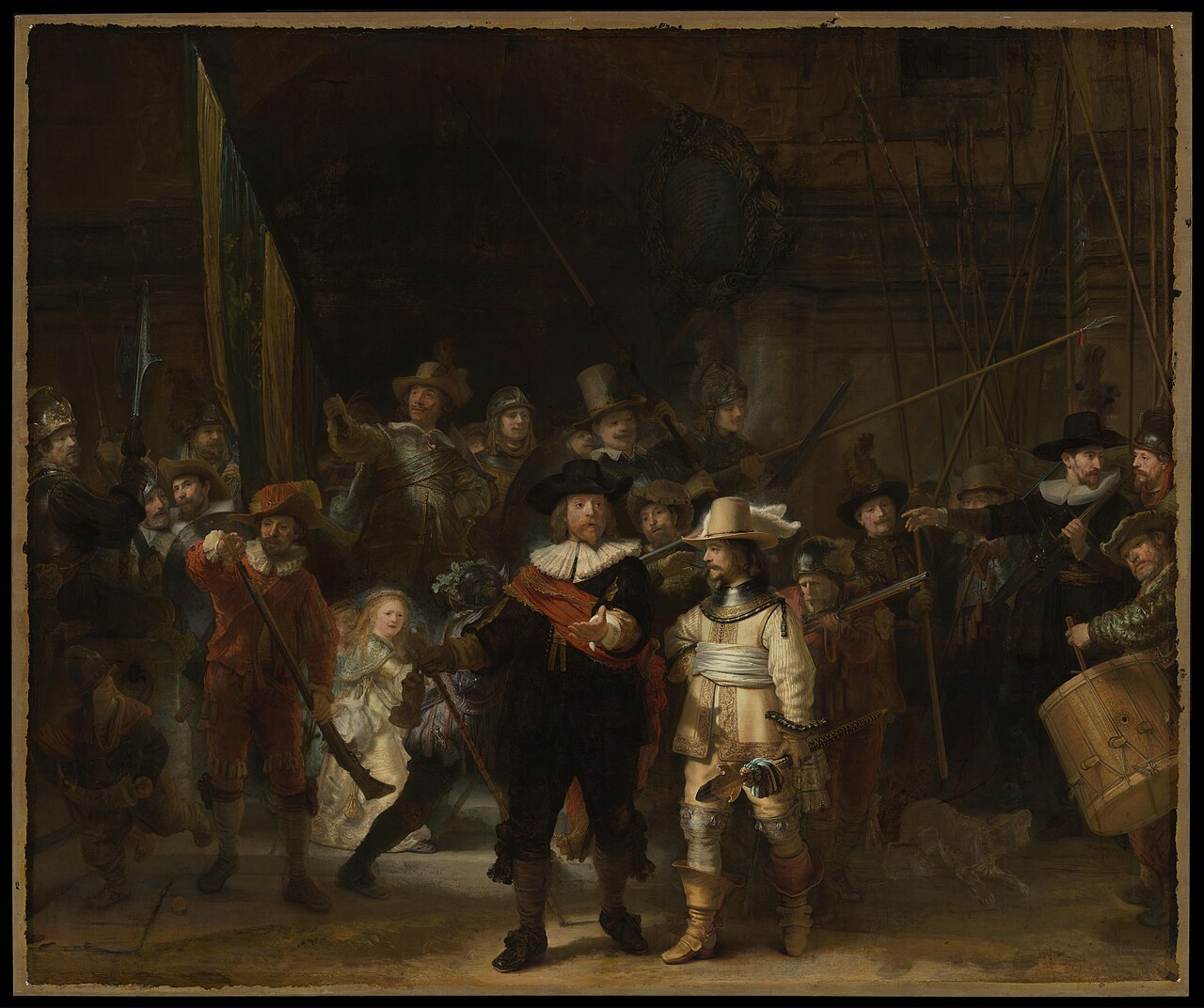
The painting that draws the longest queues in the Rijksmuseum is not actually a night scene. Centuries of darkened varnish, soot from oil lamps in private collections, and the smoke of wartime storage in caves and church crypts gradually turned the broad daylight Rembrandt had painted into something resembling moonlight. By the time the painting acquired its popular name — De Nachtwacht, The Night Watch — in the late eighteenth century, almost no one could see what it was supposed to be.
Its proper title is much less photogenic: Militia Company of District II under the Command of Captain Frans Banninck Cocq. It is a group portrait. Eighteen militiamen, three children, and a dog have crowded into a canvas almost four and a half metres wide, paying for the privilege of appearing in it. Rembrandt finished it in 1642, the year his wife Saskia died.
What the cleaning revealed
Between 2019 and 2023, the museum ran Operation Night Watch in full public view: a glass studio was built around the painting and visitors could watch a small team of conservators at work. The aim was not to repaint anything, but to understand what was there: how the layers were laid down, which retouches were later, which damages had been masked, and how the colours sat under their old varnish.
Several small revelations came out of it. A young boy in armour, on the right, turns out to be carrying a horn into which Rembrandt has painted his own initials. The dog at Cocq's feet is in motion, mid-bark, and not the still creature that previous photographs suggested. And a strip of canvas, cut off the left side in 1715 when the painting was first moved from the Kloveniersdoelen to the town hall, has been digitally reconstructed using an old copy by Gerrit Lundens. The reconstructed strip, four figures wide, is now mounted as a temporary extension so that the composition can briefly be seen the way Rembrandt left it.
Why the room is shaped the way it is
When Pierre Cuypers designed the museum in the 1870s, he and his patron Victor de Stuers built the entire long axis of the Gallery of Honour as an approach to a single picture. The room widens at its far end, like a stage, and the painting sits in its own apse. The intention was theological as much as theatrical — nineteenth-century Catholics were re-asserting the role of Dutch art history in a Protestant nation, and Cuypers wanted visitors to feel that the climb toward The Night Watch was, in some small sense, a procession.
It still works. If you stand at the far end of the gallery, near the entrance to the medieval rooms, the painting reveals itself in stages. First the figures in front, then the shadowed company behind them. Then, slowly, the architecture above the painting, which Cuypers wrapped in stained glass so the canvas would be lit from the side rather than the front.
"A history painting in which the figures stand and breathe in such a way that we ourselves would draw back to make room for them." — an early-eighteenth-century visitor, quoted in the museum's own catalogue.
Reading the painting slowly
Most visitors stop in front of the painting for perhaps ninety seconds. The militia company would, I suspect, have wanted longer. They paid a hundred guilders each to be in it, and you can see the negotiations in the result — the men who paid most stand in the brightest light, those who paid less are partly obscured by the man in front. The captain in black, with the red sash, was Banninck Cocq, an Amsterdam merchant. The lieutenant in pale yellow, beside him, was Willem van Ruytenburch. The little girl in golden brocade, half-illuminated near the centre, is most likely a symbolic figure rather than a real child — she carries a chicken's foot from her belt, a play on the company's emblem (a klauw, or claw).
None of this is hidden information; the museum's free Rijksmuseum app tells you all of it on a free guided audio walk. What I have written here is only what one reader has noticed standing in front of it on three separate visits. I would recommend the same: visit it more than once, and do not bring a guide on the first visit.
Next entry: A short walk through eight centuries of Dutch material life — on the rest of the collection.